
Enochs Interpersonal Violence Research Collaborative
Elisabeth Shirley Enochs generously provided endowment funds to the Department of Social Work to help fund a faculty member and related work on that has a focus on child and family welfare, health, and well-being, with a particular interest in communities in or from Latin American, Asia, and/or Africa.
Background on Elisabeth Shirley Enochs
Elisabeth Shirley Enochs (1890–1992) was a pioneering reformer and international advocate for the welfare of women, children, and families. Born in Indian Territory (now Oklahoma) and educated across Europe, she began her career as a journalist covering foreign affairs before joining the U.S. Children’s Bureau in 1927. Over the next several decades, Enochs helped shape national and international child welfare policy, first as an analyst and later as Chief of the Division of International Cooperation. Her leadership extended across Central and South America, where she developed programs to strengthen maternal and child health systems, train social workers, and expand access to social services. She represented the United States at major international gatherings, including the first Pan-American Congress of Social Service, and was instrumental in establishing collaborations that linked public health, education, and social welfare efforts across nations.
Throughout her career, Enochs championed cross-cultural exchange and the practical application of research to improve the lives of vulnerable populations. She served as president of the Inter-American Children’s Institute and received numerous honors for her global contributions to child and family welfare, including recognition from the U.S. Department of Health, Education, and Welfare and the government of Venezuela.
Her enduring commitment to advancing the social welfare of families, women, and children lives on through the Elisabeth Shirley Enochs Endowment at George Mason University, which supports research, training, and community partnerships that promote wellbeing both locally and globally. This collaborative continues Enochs’s lifelong vision of international cooperation and social progress, carrying forward her legacy of using scholarship and collaboration to strengthen systems of care and improve lives.
Reference:
Fahringer, A. T. (2015). Elisabeth Randolph Shirley Enochs (1890–1992). In Dictionary of Virginia Biography. Library of Virginia. http://www.lva.virginia.gov/public/dvb/bio.asp?b=Enochs_Elisabeth_Randolph_Shirley
Enochs Interpersonal Violence Research Collaborative:
Funds from the Enochs Endowment are used to support the Enochs Interpersonal Violence Research Collaborative at George Mason University. Under the direction of Dr. Denise A. Hines, the Enochs Endowed Professor in the Department of Social Work, this collaborative is a multidisciplinary initiative that brings together faculty across the social sciences and STEM fields to foster collaboration, knowledge sharing, and strategic development in interpersonal violence research.
The collaborative provides funding for cross-college projects, facilitates peer collaboration, offers expert consultation and strategic planning, and hosts regular meetings throughout the academic year to support research development and strengthen connections across the university. Its mission is to advance research, inform evidence-based practice and policy, and ultimately reduce the prevalence and impact of interpersonal violence by building coordinated, interdisciplinary approaches and strengthening systems of care for affected individuals, families, and communities.
Funded Positions:

Denise A. Hines, Ph.D., Enochs Endowed Professor of Social Work, College of Public Health at George Mason University. Dr. Hines’ expertise includes the causes, consequences, and prevention of family violence and sexual assault, with a particular focus on under-recognized victims of intimate partner violence. She also has a specialization in translating university-based research for policymakers.
Dr. Hines’ work on under-recognized victims of intimate partner violence has been supported by grants from the National Institute of Mental Health, the National Institute of Child Health and Human Development, and currently by a private law firm. Her interpersonal violence prevention work has been supported by three grants from the U.S. Department of Justice and the U.S. Department of Education.
Dr. Hines is the author of over 95 peer-reviewed articles and book chapters, and two books on issues of family violence, one of which – Family Violence in the United States – is currently in its third edition. She is a co-editor of the recently released Routledge Handbook on Men’s Victimization in Intimate Relationships. She has spoken about her work in front of various audiences, including workshops for continuing medical education, state coalitions against domestic violence, the National Resource Center on Domestic Violence, the Massachusetts State legislature, the Connecticut State legislature, the White House domestic policy staff, staff of the Senate Judiciary Committee, the FBI, and Canadian Parliament.
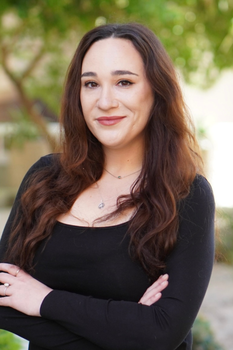
Lyric N. Russo, PhD, Enochs Endowed Postdoctoral Research Fellow, Department of Social Work, College of Public Health, George Mason University. Dr. Russo’s research examines how trauma and adversity shape social judgment, relational decision-making, and perceptions of risk in the context of interpersonal violence. Her work focuses on historically underrepresented and under-resourced families, as well as marginalized survivors of violence, and aims to inform prevention efforts and strengthen systems of care that promote safety, wellbeing, and healthy relationships. Supported by the Elisabeth Shirley Enochs Endowment, her research integrates mixed-methods and community partnerships to advance evidence-based approaches for supporting vulnerable populations.
Funded Projects:
Four multidisciplinary pilot projects addressing interpersonal violence are funded by the Enochs Endowment:
Understanding and measuring intimatepartner violence and reproductive coercionamong people experiencing infertility
PI: Dr. Karen Trister Grace, School of Nursing, College of Public Health
Co-I: Dr. Ben Seiyon Lee, Department of Statistics, College of Engineering and Computing
EA$E-US: IPV prevention in Congolese Refugees in Phoenix
PI: Dr. Jhumka Gupta, Department of Global and Community Health, College of Public Health
Co-I: Dr. Bethany Letiecq, School of Education, College of Education and Human Development
Resilient futures: Empowering adolescents &young adults for healthy relationships
Co-PI: Dr. Amira Roess, Department of Global and Community Health, College of Public Health
Co-PI: Dr. Leah Adams, Department of Psychology, College of Humanities and Social Sciences
Improving detection of inflicted bruises using ultrasound imaging
Co-PI: Dr. Katherine Scafide, School of Nursing, College of Public Health
Co-PI: Dr. Siddhartha Sikdar, Department of Bioengineering, College of Engineering and Computing
In addition to supporting research, the endowment funds guest speakers to visit campus and share their expertise on topics related to interpersonal violence, fostering knowledge exchange, collaboration, and professional development. By supporting these diverse projects and initiatives, the endowment aims to advance understanding of interpersonal violence and inform evidence-based practice and policy to strengthen systems of care and promote safety and wellbeing for affected communities.